
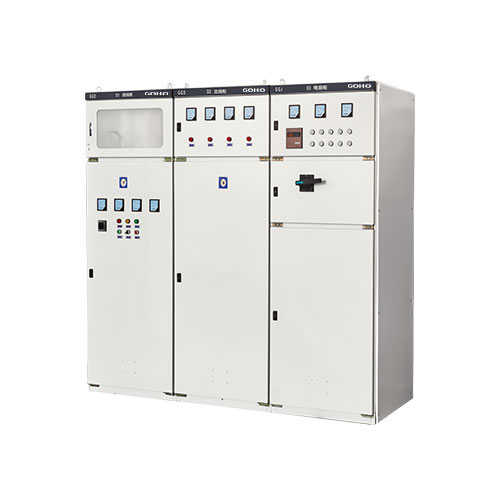
GGJ Low Voltage Capacitor Cabinet
GGJ low voltage capacitor cabinet (also known as reactive power automatic compensation device) is designed to improve power factor, reduce line losses, and enhance power quality in low voltage distribution systems. Manufactured by GOHO in accordance with IEC 61439, IEC 60831, and GB/T 15576 standards, the GGJ series automatically switches capacitor banks in and out based on real-time power factor measurement, maintaining a target power factor (typically 0.92–0.99) without manual intervention.
The cabinet integrates an intelligent microprocessor-based reactive power controller, self-healing low voltage shunt capacitors (MKP/MKK metallized film type), detuning reactors (optional for harmonic suppression), and switching devices (contactor or thyristor) into a standardized metal-enclosed enclosure. The controller continuously monitors the power factor of the load side via current transformer (CT) and voltage transformer (PT) inputs and automatically switches capacitor steps to maintain the preset target power factor.
By installing GGJ capacitor cabinets, industrial and commercial users can significantly reduce electricity costs by avoiding power factor penalty charges imposed by utility companies for operation below the contractual power factor threshold (typically 0.85–0.90), while simultaneously optimizing energy consumption through reduced I²R losses in distribution cables and transformers.
Technical Specifications
| Item | Specification |
|---|---|
| Rated Working Voltage | 380V / 400V / 415V AC |
| Rated Frequency | 50Hz / 60Hz |
| Rated Compensation Capacity | 30kVar – 1200kVar (customizable in modular steps) |
| Step Configuration | 4, 6, 8, 10, or 12 steps (automatic switching) |
| Step Capacity per Bank | 10kVar – 100kVar (configurable) |
| Target Power Factor | 0.92 – 0.99 (adjustable via controller) |
| Accuracy of Power Factor Control | ±0.01 |
| Response Time | ≤ 20 seconds (contactor switching) / ≤ 20ms (thyristor switching) |
| Switching Device | AC contactor / Thyristor (TSC — Thyristor Switched Capacitor) |
| Controller Type | Intelligent microprocessor-based reactive power controller with digital display |
| Capacitor Type | Self-healing low voltage shunt capacitor (MKP / MKK metallized polypropylene film) |
| Capacitor Dielectric Loss | ≤ 0.2 W/kVar |
| Capacitor Overvoltage Capability | 1.1 × Un (continuous) / 1.3 × Un (1 minute) |
| Detuning Reactor | 7% (for dominant 5th and 7th harmonics) or 14% (for dominant 3rd harmonics) |
| Harmonic Suppression | Up to 95% reduction of dominant harmonic current at tuning frequency |
| Degree of Protection | IP30 / IP40 |
| Enclosure Material | Cold-rolled steel with epoxy powder coating |
| Cooling Method | Natural air convection (forced fan cooling for high-capacity units) |
| Standards | IEC 61439, IEC 60831, GB/T 15576 |
Key Features
- Automatic Power Factor Correction: The intelligent microprocessor-based controller continuously monitors real-time power factor via CT and PT inputs and automatically switches capacitor banks in or out to maintain the preset target power factor (typically 0.92–0.99), eliminating the need for manual capacitor switching and ensuring optimal power factor under varying load conditions throughout the day
- Significant Energy Cost Reduction: Power factor penalty charges imposed by utility companies for operation below the contractual power factor threshold (typically 0.85–0.90) can increase electricity bills by 5–15% or more depending on local tariff structures — the GGJ capacitor cabinet eliminates these penalties by maintaining power factor above the required threshold, with typical payback periods of 6–18 months depending on installed capacity and local electricity tariffs
- Reduced I²R Losses: Improving power factor from 0.75 to 0.95 reduces line current by approximately 21% for the same active power delivery, correspondingly reducing I²R losses in cables, transformers, and switchgear by approximately 37% — extending equipment life and reducing cooling load in distribution rooms
- Self-Healing Capacitor Technology: MKP/MKK metallized polypropylene film capacitors feature self-healing capability — in the event of a dielectric breakdown, the metallized layer around the fault point vaporizes, isolating the fault and restoring normal operation without capacitor failure, unlike conventional foil-type capacitors which would permanently short-circuit
- Capacitor Overpressure Disconnection: Each capacitor element is equipped with an overpressure disconnection device — in the event of end-of-life failure at maximum overpressure, the internal disconnect mechanism permanently isolates the failed element from the circuit, preventing explosive rupture or fire
- Optional Harmonic Protection: Integrated detuning reactors (7% or 14% tuning) prevent series and parallel resonance between the capacitor bank and system inductance, protect capacitors from harmonic overload and premature aging, and provide passive harmonic filtering — the 7% tuning (189Hz) is recommended for systems with dominant 5th and 7th harmonics common in industrial environments with variable frequency drives (VFDs) and UPS systems
- User-Friendly Digital Controller: Real-time display of power factor, voltage, current, active power, reactive power, harmonic distortion, and system status with password-protected parameter settings, historical data logging, and RS485 communication for remote monitoring integration
- Flexible Switching Options: Standard AC contactor switching provides cost-effective operation for normal speed applications, while optional thyristor (TSC) zero-crossing switching eliminates inrush current and transient overvoltages during capacitor switching — ideal for applications with sensitive electronic loads or frequent switching requirements
- Overvoltage and Undervoltage Protection: The controller automatically disconnects capacitor banks during overvoltage conditions (≥ 110% rated voltage) and undervoltage conditions (≤ 80% rated voltage), and automatically restarts when voltage returns to normal range — preventing capacitor damage and ensuring safe automatic operation
Applications
- Industrial plants — motor loads, welding machines, induction furnaces, compressors, and pumps
- Commercial buildings — HVAC systems, elevators, escalators, and lighting
- Power systems — substation reactive power compensation and voltage support
- Mining — heavy machinery power factor correction and harmonic mitigation
- Oil and gas — pump stations, compressor loads, and pipeline facilities
- Data centers — UPS input power factor correction and harmonic reduction
- Wastewater treatment plants — variable speed drive (VFD) power factor correction