
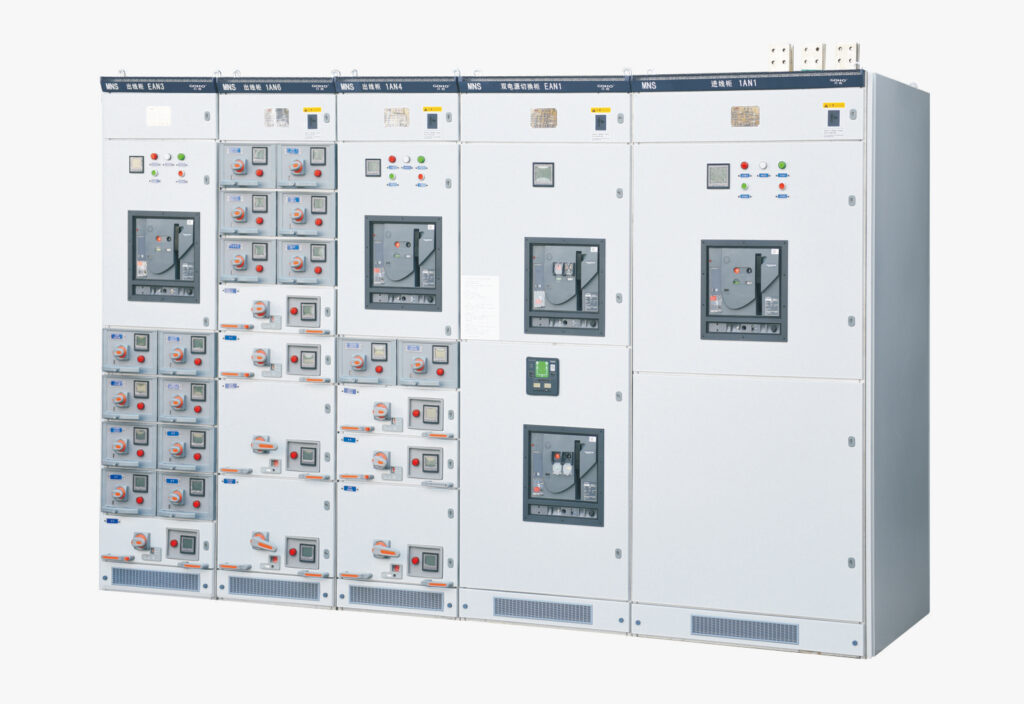
MNS Low Voltage Withdrawable Switchgear
MNS series low-voltage withdrawable switchgear — a modular, multi-functional power distribution and motor control system rated up to 6300A with 80kA short-time withstand. IEC 61439 type-tested, featuring 3-position draw-out mechanism, full compartmentalization, and high-interchangeability drawer units. The premium LV switchboard solution for power plants, heavy industry, and critical infrastructure.
Premium Modular LV Distribution System
IEC 61439 type-tested withdrawable switchgear for high-reliability industrial and infrastructure applications
The MNS low voltage withdrawable switchgear is a modular, multi-functional power distribution system designed for applications requiring the highest levels of reliability, flexibility, and maintainability. Manufactured by GOHO in full compliance with IEC 61439-1 and IEC 61439-2 standards, the MNS switchgear is widely used in metallurgy, petrochemical, industrial and mining enterprises, power plants, and large-scale infrastructure projects for power distribution, motor control, and reactive power compensation.
The MNS series adopts a withdrawable (draw-out) unit design, allowing circuit breakers, contactors, and functional units to be easily removed for maintenance, inspection, or replacement without shutting down the entire switchboard system. The draw-out mechanism features clearly defined Connected, Test, and Disconnected positions with mechanical interlocks ensuring safe operation — a faulty unit can be withdrawn and replaced with a spare in minutes, significantly improving system uptime and operational flexibility compared to fixed-mounting alternatives.
The enclosure is constructed from cold-rolled steel plate with epoxy powder coating, with full compartmentalization between busbar, functional unit, cable, and control compartments for enhanced safety and arc fault containment. The robust busbar system uses high-conductivity T2 electrolytic copper with silver-plated contact surfaces, rated up to 6300A with short-time withstand of up to 80kA — making it suitable for the most demanding heavy industrial and power generation applications.
- Up to 6300A main busbar — T2 electrolytic copper, silver-plated contacts
- 80kA short-time withstand — handles the most demanding fault conditions
- 3-position draw-out mechanism — Connected / Test / Disconnected
- Full compartmentalization — busbar / functional unit / cable / control
- High interchangeability — same-spec drawers fully interchangeable
- IEC 61439 type tested — full verification of design and performance
Detailed Parameters
Complete technical specifications for MNS series low voltage withdrawable switchgear
| Parameter | Specification |
|---|---|
| Rated Insulation Voltage (Ui) | 660V / 1000V |
| Rated Working Voltage (Ue) | 380V / 400V / 415V / 660V |
| Rated Frequency | 50Hz / 60Hz |
| Rated Current (Main Busbar) | Up to 6300A |
| Rated Current (Branch Busbar) | Up to 1200A |
| Rated Short-Time Withstand (Icw, 1s) | 50kA / 65kA / 80kA |
| Rated Peak Withstand Current (Ipk) | 105kA / 143kA / 176kA |
| Busbar Material | T2 high-conductivity electrolytic copper, full silver-plated contacts |
| Busbar Connection | Bolted joint with double-nut locking |
| Degree of Protection | IP30 / IP40 (standard), IP54 (optional) |
| Enclosure Material | Cold-rolled steel plate / Stainless steel (optional) |
| Steel Plate Thickness | 2.0 – 2.5mm (main structure) |
| Surface Treatment | Epoxy powder coating, RAL 7035 (standard) / customizable |
| Unit Types | Fixed / Plug-in / Withdrawable (draw-out) |
| Drawer Unit Sizes | 1/4 unit, 1/2 unit, 1 unit, 2 unit, 3 unit |
| Drawer Positions | Connected / Test / Disconnected (3-position) |
| Drawer Interlock | Mechanical + electrical — prevents draw-out when CB closed |
| Shutter Mechanism | Automatic shutter covers live contacts when drawer removed |
| Compartmentalization | Busbar / Functional unit / Cable / Control — fully separated |
| Arc Fault Containment | Pressure-relief flaps, compartmentalized design |
| Functional Unit Types | Incoming feeder, Outgoing feeder, MCC, Capacitor bank, ATS, Lighting, Auxiliary |
| Breaker Compatibility | ACB (up to 6300A), MCCB, MCB, RCBO — all major brands |
| Cable Termination | Top entry / Bottom entry / Side entry — single or multi-cable |
| Cable Section Range | Up to 300mm² per phase (multi-cable configurable) |
| Ambient Temperature | -5°C to +40°C (derating above 40°C) |
| Ambient Humidity | ≤ 95% (non-condensing) |
| Altitude | ≤ 2000m (derated above) |
| Installation Type | Indoor, floor-standing, fixed installation |
| Standards | IEC 61439-1, IEC 61439-2, GB 7251.1 |
| Type of Construction | Form 2b / Form 3a / Form 3b / Form 4a / Form 4b |
Why Choose MNS Switchgear
Premium withdrawable LV switchboard with type-tested reliability and maximum operational flexibility
Modular Multi-Functional Design
Flexible combination of fixed, plug-in, and withdrawable unit configurations within a single switchboard — supporting incoming feeders, outgoing feeders, MCC, capacitor banks, ATS, lighting distribution, and auxiliary power supply all in one unified system.
High Interchangeability
Drawer units of the same specification are fully mechanically and electrically interchangeable, simplifying spare parts management and enabling rapid unit replacement — a critical advantage for continuous-process industries where every minute of downtime directly impacts production output.
3-Position Draw-Out Mechanism
The draw-out mechanism provides three clearly defined positions — Connected, Test, and Disconnected — with automatic shutters covering live busbar contacts when the drawer is removed. The test position allows functional testing of control and protection circuits without energizing the main power circuit.
High Short-Circuit Rating
Main busbar system rated up to 80kA short-time withstand current (Icw) and 176kA peak withstand current (Ipk), ensuring safe and reliable operation under the most demanding fault conditions encountered in heavy industrial, petrochemical, and power generation applications.
Arc Flash Protection
Full compartmentalization with physical separation between busbar, functional unit, cable, and control compartments limits arc fault energy propagation. Pressure-relief flaps at the top of each compartment safely direct arc gases to designated exhaust areas away from personnel.
IEC 61439 Type Tested
Fully type-tested assembly (TTA) in accordance with IEC 61439-1 and IEC 61439-2, including verification of dielectric properties, temperature rise, short-circuit withstand, and protection circuit integrity — ensuring verified performance you can trust.
Robust Busbar System
Main busbar rated up to 6300A using high-conductivity T2 electrolytic copper with full silver-plated contact surfaces and bolted double-nut connections, ensuring minimal temperature rise and reliable power transfer under continuous full-load operation.
Flexible Cable Termination
Generous cable compartment dimensions accommodate multiple cable entries per circuit with easily accessible termination points. Supports top, bottom, and side cable entry configurations — reducing installation time and simplifying future circuit modifications.
Comprehensive Interlocking
Mechanical and electrical interlocks prevent incorrect operations including drawing-out or drawing-in the drawer while the circuit breaker is in the closed position, and prevents closing the breaker in intermediate positions — protecting both personnel and equipment.
Where MNS Switchgear Excels
Premium LV withdrawable switchgear for critical industrial and infrastructure power distribution
Power Plants
Auxiliary power, unit control & MCC
Petrochemical
Refinery MCC & process distribution
Metallurgy
Rolling mills, furnaces & crane power
Commercial Buildings
High-rise MDB, lighting & HVAC
Water & Wastewater
Pump stations & treatment plants
Data Centers
Critical power distribution & UPS
Infrastructure
Airports, hospitals, railways
Mining
Underground & open-pit mine power
Quality & Compliance
Type-tested and certified for reliable low voltage switchgear performance
IEC 61439-1/2
LV switchgear type-tested assembly standard
ISO 9001
Quality management system certified
IEC 60947
Low-voltage switchgear & controlgear
Type Tested (TTA)
Full design verification testing
Frequently Asked Questions
Common questions about MNS low voltage withdrawable switchgear
These three represent different tiers and design philosophies in LV switchgear. GGD is the most basic — a fixed-type low voltage distribution cabinet with no withdrawable units, designed for simple power distribution applications where maintenance flexibility is less critical. It's the most economical option. GCS is a mid-range withdrawable switchgear with a focus on motor control center (MCC) applications, featuring 1/2-unit, 1-unit, and larger drawer sizes, but with lower short-circuit ratings and a more compact design. MNS is the premium platform — it offers the highest current ratings (up to 6300A), highest short-circuit withstand (up to 80kA), the most flexible modular design (supporting fixed, plug-in, and withdrawable units in the same board), and full compartmentalization for maximum safety. MNS is typically specified for heavy industrial, power generation, and critical infrastructure applications where reliability, maintainability, and fault withstand capability are paramount.
Withdrawable (draw-out) means the functional unit — containing the circuit breaker, contactors, relays, and other components — is mounted on a drawer chassis that can be physically pulled out of the switchgear cubicle. This allows maintenance, testing, or replacement of a faulty unit without de-energizing the entire switchboard. The three positions are: (1) Connected position — the drawer is fully inserted, both power and control circuits are engaged, the unit is in normal operation. (2) Test position — the drawer is partially withdrawn, power contacts are disconnected but control circuit contacts remain engaged, allowing functional testing of protection and control circuits without energizing the main circuit. Automatic shutters cover the live busbar contacts for safety. (3) Disconnected position — the drawer is fully withdrawn (or removed), both power and control circuits are disconnected, the unit is electrically isolated and can be safely removed for service or replacement. Each position is clearly indicated and mechanically interlocked.
Form classification (defined in IEC 61439) describes the degree of internal separation within a low voltage switchgear assembly. The forms range from Form 1 (no internal separation) to Form 4b (full separation of busbars, functional units, and terminals). Form 2 — busbars separated from functional units. Form 3 — busbars and functional units separated from each other, with terminals either external or within the same compartment. Form 4 — busbars, functional units, and cable terminals all separated from each other, with sub-forms 4a (terminals within the functional unit compartment but separated) and 4b (terminals in a separate compartment). MNS switchgear can be configured up to Form 4b, providing the highest level of internal arc containment and personnel protection. Higher form classifications improve safety but increase cost and physical size, so the appropriate form should be selected based on the application risk assessment and local electrical safety regulations.
Short-circuit withstand rating must be greater than the maximum available fault current at the point of installation. To determine the required rating: (1) Calculate the prospective short-circuit current at the switchgear location based on the supply transformer capacity, impedance, and upstream system impedance. (2) Select a switchgear rating with Icw (short-time withstand) and Ipk (peak withstand) that exceed the calculated fault current. Common MNS ratings are 50kA / 105kA peak, 65kA / 143kA peak, and 80kA / 176kA peak. For reference: a 1000kVA transformer at 400V with 4% impedance gives roughly 36kA fault current — well within 50kA rating. A 2500kVA transformer at 4% impedance gives roughly 90kA — requiring 65kA or higher. Heavy industrial sites with multiple parallel transformers or generator backup can easily exceed 80kA. Always have a qualified electrical engineer perform a fault current study. When in doubt, specify the next higher rating — the cost difference is small compared to the risk of catastrophic failure.
Yes, one of the key advantages of the MNS system is its ability to mix fixed, plug-in, and withdrawable units within the same switchboard. This allows you to optimize cost and flexibility: use withdrawable units for critical circuits that require frequent maintenance or quick replacement (like motor feeders in an MCC), and use fixed units for less critical or rarely-modified circuits (like main incoming or bus tie breakers). The modular design ensures mechanical and electrical compatibility across all unit types. Common configurations include: incoming section with fixed ACB + distribution section with withdrawable MCC feeders, or a mixed board with some fixed feeder panels and some withdrawable motor control panels. Our engineering team can help you optimize the configuration based on your single-line diagram, criticality analysis, and maintenance strategy.
MNS switchgear is designed for long service life with minimal maintenance, but regular inspection is recommended to ensure reliability. Typical maintenance tasks include: (1) Visual inspection — check for overheating signs, corrosion, damage, and cleanliness (quarterly). (2) Connection tightness check — verify busbar and terminal connections are properly torqued, especially after installation or modification (annually, or after any modification). (3) Drawer mechanism inspection — test draw-out/insert operation, verify interlocks function correctly, clean and lubricate guides if needed (annually). (4) Insulation resistance test — measure insulation resistance of busbars and circuits to ground (every 2–3 years or after environmental exposure). (5) Protection relay testing — verify relay settings and operation (annually or per site policy). (6) Cleaning — remove dust accumulation from compartments and ventilation openings (as needed based on environment). The withdrawable design makes maintenance much easier — a faulty drawer can be simply swapped with a spare, minimizing downtime. Always follow proper lockout/tagout procedures and consult the maintenance manual for detailed instructions.


Need Premium LV Withdrawable Switchgear?
Send us your single-line diagram and fault current requirements. We'll configure the right MNS solution — including current ratings, form classification, drawer sizes, and breaker selection — with a factory quote in 24 hours.