
Switchgear for EV Charging Stations
Switchgear
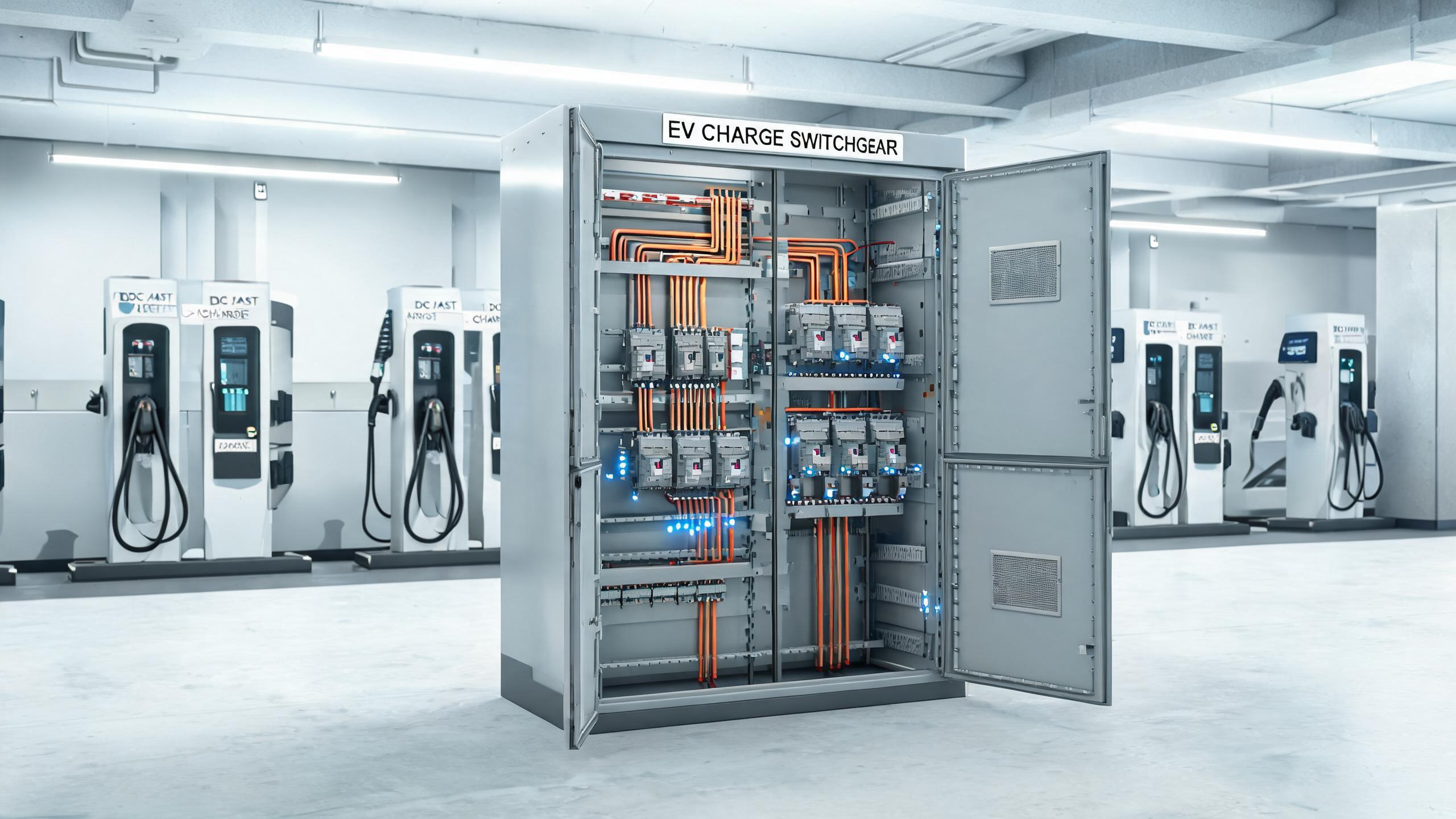
Complete MV-LV switchgear solutions engineered for the unique demands of electric vehicle charging infrastructure. IEC 61439 type-tested, harmonic-resistant, and ready for rapid deployment.
Key Specs at a Glance
Industry-leading performance metrics across our EV charging switchgear lineup
The EV Charging Revolution Requires Robust Switchgear
Global EV charging infrastructure is expanding at unprecedented speed — and every new charger needs reliable, safe, and efficient power distribution equipment.
Why EV Charging Switchgear Is Different
EV chargers are nonlinear loads that create unique challenges for distribution equipment. Standard switchgear won’t last — you need EV-optimized designs.
🔴 High Short-Circuit Currents
DC fast chargers draw high inrush currents and create fault conditions far beyond typical commercial loads. Standard LV panels rated for 25kA may not be sufficient for large charging hubs.
GOHO Solution: 50-80kA short-circuit withstand rating on GCK/MNS series
🟠 Harmonic Distortion
AC/DC converters in chargers generate 5th, 7th, and 11th harmonics. Without mitigation, THD can exceed 30%, causing overheating, equipment damage, and poor power factor.
GOHO Solution: Integrated APF + SVG harmonic compensation packages
🟡 Frequent Switching Operations
Charging sessions start and stop constantly throughout the day. This means more frequent circuit breaker operations, contact wear, and mechanical stress compared to steady industrial loads.
GOHO Solution: 10,000+ mechanical/electrical operation life on breakers
🟢 Selective Protection Coordination
When one charger faults, it must not take down the entire station. Proper selective coordination between MV breakers, LV main breakers, and feeder breakers is critical for uptime.
GOHO Solution: Full protection coordination studies included with every project
IEEE 519 Harmonic Distortion Limits
Industry standards for power quality in EV charging installations
| Parameter | Limit Value | Application | Standard Reference |
|---|---|---|---|
| Voltage THD (Total Harmonic Distortion) | < 5% | General systems | IEEE 519-2022 |
| Current TDD (Total Demand Distortion) | 8-15% | Depends on system size | IEEE 519-2022 |
| Individual Odd Harmonics (3rd-11th) | 4-10% | Voltage harmonics | IEEE 519 Table 2 |
| Power Factor (Target) | ≥ 0.95 | Most utility requirements | Utility tariffs |
| EV Charger THID (Typical) | 15-30% | Without mitigation | Field measurements |
Complete Product Range for EV Charging
From medium-voltage distribution to low-voltage power factor correction, we supply every switchgear component your charging station needs.
HXGN15-12 RMU
SF6 Insulated Ring Main Unit – 630A / 20kA
KYN28-12 VCB
Withdrawable Vacuum Breaker Panel – 1250-3150A
GGD Fixed Type
Fixed-Mounted LV Distribution Panel – Up to 3150A
MNS Withdrawable
Modular Withdrawable LV Switchgear – Up to 6300A
GGJ Compensation
Automatic PFC with Detuned Reactors – 100-600 kVAR
Medium Voltage Switchgear (12kV)
HXGN15-12 RMU
SF6 Insulated Ring Main Unit
| Rated Voltage | 12 kV |
| Rated Current | 630 A |
| Insulation | SF6 Gas |
| Short-Time Withstand | 20 kA / 3s |
| Protection | Load break + SF6 fuse |
| Standard | IEC 62271-200 |
KYN28-12
Withdrawable VCB Panel
| Rated Voltage | 12 kV |
| Rated Current | 1250 – 3150 A |
| Breaker Type | Vacuum Circuit Breaker |
| Short-Time Withstand | 31.5 – 40 kA / 4s |
| Withdrawable | Yes (VBC truck) |
| Standard | IEC 62271-200 |
Low Voltage Switchgear (400V)
GGD Fixed Type
Fixed-Mounted LV Distribution Panel
| Rated Voltage | 400 V / 690 V |
| Rated Current | Up to 3150 A |
| Short-Circuit Rating | 50 kA (1s) |
| Busbar System | Copper, horizontal + vertical |
| Mounting | Fixed (bolted connections) |
| Standard | IEC 61439-2 |
MNS Withdrawable
Modular Withdrawable LV Switchgear
| Rated Voltage | 400 V / 690 V |
| Rated Current | Up to 6300 A |
| Short-Circuit Rating | 80 kA (1s) |
| Busbar System | Double-sided copper busbar |
| Mounting | Fully withdrawable drawers |
| Standard | IEC 61439-2 |
Power Factor & Harmonic Compensation
GGJ Capacitor Compensation Cabinet
Automatic Power Factor Correction with Detuned Reactors
| Rated Voltage | 400 V / 480 V |
| Capacitance Range | 100 – 600 kVAR |
| Reactor Type | Detuned (7% / 14%) |
| Control | 12-step automatic controller |
| THD Reduction | Up to 30% current THD |
| Standard | IEC 61439-2 |
Complete End-to-End Solution
One supplier, one point of contact, one quality standard across your entire charging infrastructure.
MV Switchgear
HXGN15-12 RMU or KYN28-12 VCB panel for grid connection
Transformer
12kV / 400V dry-type or oil-immersed distribution transformer
LV Switchgear
GGD or MNS main distribution panel with charger feeders
PFC & Harmonic
GGJ capacitor bank with detuned reactors for power quality
EV Chargers
DC fast chargers and AC Level 2 charging stations
Typical Configuration by Station Size
Reference switchgear configurations based on EV charging station capacity and power requirements.
| Station Size | MV Switchgear | LV Switchgear | PFC / Harmonic | Example Application |
|---|---|---|---|---|
| Small (4-8 chargers, up to 500kW) | HXGN15-12 RMU (630A) | GGD (1250A) | GGJ-100 kVAR | Urban parking garage, small retail charging |
| Medium (8-16 chargers, 500-1500kW) | KYN28-12 (1250A VCB) | GGD (2500A) + distribution | GGJ-200 kVAR detuned | Highway rest stop, commercial hub |
| Large (16-40 chargers, 1.5-5MW) | KYN28-12 (2000A VCB, dual bus) | MNS withdrawable (4000A) | GGJ-400 kVAR (multi-step) | Urban fast charging hub, fleet depot |
| Megahub (40+ chargers, 5MW+) | KYN28-12 (3150A, dual incoming) | MNS withdrawable (6300A, N+1) | GGJ-600 kVAR + AHF option | Solar+storage+charging complex, mega hub |
| Transformer Size (kVA) | Rated LV Current (A) | Recommended Icw (kA/1s) | GOHO Switchgear Model | Typical Station Capacity |
|---|---|---|---|---|
| 250 kVA | 361 A | 25 kA | GGD-630A | 2-4 chargers (up to 200kW) |
| 500 kVA | 722 A | 35 kA | GGD-1250A | 4-6 chargers (up to 400kW) |
| 800 kVA | 1,155 A | 50 kA | GGD-2000A | 6-10 chargers (up to 640kW) |
| 1,250 kVA | 1,804 A | 50 kA | GGD-2500A / MNS-2500A | 8-16 chargers (up to 1MW) |
| 2,000 kVA | 2,887 A | 65 kA | MNS-3200A | 16-24 chargers (up to 1.6MW) |
| 3,150 kVA | 4,547 A | 80 kA | MNS-5000A | 24-40 chargers (up to 2.5MW) |
| 5,000 kVA | 7,217 A | 80 kA (split bus) | MNS-6300A (dual section) | 40+ chargers (5MW+ megahub) |
| IP Rating | Protection Level | Environment Type | Typical EV Charging Application | Available Models |
|---|---|---|---|---|
| IP20 | Finger protection, no water resistance | Dedicated electrical room, clean indoor | Indoor switchgear rooms in commercial buildings | GGD, MNS, KYN28 |
| IP30 | Tool protection (2.5mm), no water resistance | Indoor electrical room, controlled access | Basement electrical rooms, parking garage E-rooms | GGD, MNS, KYN28 |
| IP40 | Wire protection (1mm), no water resistance | Indoor with dust exposure, industrial areas | Fleet depot electrical rooms, industrial charging | GGD, MNS |
| IP54 | Dust-protected, splash-proof from all directions | Outdoor kiosk, covered outdoor areas | Highway rest stops, outdoor parking lot kiosks | GGD outdoor, RMU kiosk |
| IP55 | Dust-protected, water jet resistant | Outdoor exposed, harsh weather conditions | Coastal charging stations, heavy rainfall regions | Custom outdoor enclosure |
| IP65 | Dust-tight, water jet resistant | Severe outdoor, dusty or coastal environments | Desert solar+charging sites, coastal mega hubs | Custom stainless steel enclosure |
Key Design Features for EV Charging
Our switchgear is engineered with EV charging-specific requirements in mind, addressing the unique electrical challenges of DC fast chargers.
Type B RCD for DC Fault Protection
Equipped with Type B residual current devices that detect both AC and smooth DC residual currents, essential for protecting against DC faults from EV charger rectifier circuits as required by IEC 60364-7-722.
Harmonic-Rated Busbars
Oversized copper busbars with increased cross-sectional area and special skin-effect considerations, rated for the high harmonic content typical of multi-charger installations where current THD can reach 20-40%.
Surge Protection Coordination
Integrated Type 1+2 surge protection devices (SPDs) on both MV and LV sides, coordinated to protect sensitive charger electronics from lightning and switching surges common in outdoor charging installations.
Remote Monitoring Ready
Built-in Modbus RTU/TCP communication with smart circuit breakers and energy meters, enabling real-time monitoring of power quality, consumption, and fault diagnostics via your SCADA or energy management system.
Modular Design for Easy Expansion
Flexible modular architecture allows adding charger feeders or increasing capacity without replacing the main switchgear. Future-proof your investment as your charging network grows from a few stalls to a full hub.
IP54 Outdoor Rated Options
Enclosures available in IP30 for indoor electrical rooms and IP54 for outdoor kiosk installations, with corrosion-resistant coatings suitable for highway rest stops, parking lots, and remote locations.
4-Layer Protection Coordination
Graduated protection hierarchy ensures selective tripping and maximum uptime for your charging network
Layer 1: MV Breaker
12kV VCB with overcurrent & earth fault protection. Main incoming protection.
Layer 2: LV Main ACB
Air circuit breaker with LSIG protection. Transformer secondary & busbar protection.
Layer 3: Feeder MCCB
Molded case breaker per charger feeder. Selective protection for each circuit.
Layer 4: Charger RCD
Type B RCD + charger internal protection. Point-of-use fault isolation.
Application Scenarios
Our switchgear solutions serve EV charging infrastructure across diverse environments and use cases.
Highway Rest Stops
Outdoor-rated switchgear for fast charging corridors, with surge protection and remote monitoring for unmanned sites.
Urban Fast Charging Hubs
High-density LV switchgear for city-center charging hubs with 10-40 fast chargers and dynamic load management.
Commercial Parking
LV distribution panels for office buildings, shopping malls, and mixed-use developments with Level 2 and DC charging.
Fleet Depots
Heavy-duty switchgear for bus, truck, and delivery fleet charging with high uptime requirements and scheduled charging.
Solar + Storage + Charging
Integrated switchgear for microgrid applications combining PV generation, battery storage, and EV charging infrastructure.
Switchgear Selection by Station Size
Choose the right MV/LV switchgear combination based on your charging station capacity and number of chargers.
| Station Type | Chargers | Total Power | MV Switchgear | LV Switchgear | Recommended |
|---|---|---|---|---|---|
| Small Charging Station | ≤ 4 units | ≤ 500 kW | HXGN15-12 RMU | GGD Fixed-Type | GGD + RMU |
| Medium Charging Station | 8 – 12 units | 1 – 2 MW | KYN28-12 | GCK Draw-Out | KYN28 + GCK |
| Large Charging Hub | 20 – 40 units | 3 – 6 MW | KYN28-12 (2+ sections) | GCK + MNS + GGJ | Full Package |
| Super Charging Hub | 40+ units | 10MW+ | KYN28-12 / XGN66 | MNS + GCK + GGJ + APF | Custom Design |
Protection Coordination for EV Charging Stations
Layered protection ensures that a fault in one charger doesn’t cascade to the entire station — maximizing uptime and safety.
| Protection Layer | Equipment | Function | Typical Rating | GOHO Product |
|---|---|---|---|---|
| MV Incoming Protection | VCB + Protection Relay | Overcurrent, Earth Fault, Over/Under Voltage | 630-1250A / 25-40kA | KYN28-12 |
| Transformer Protection | LV ACB + Protection Relay | Long/Short/Instantaneous, Ground Fault | 1250-4000A / 50-80kA | GCK / MNS Main |
| Feeder Protection | MCCB / MCCB with EL | Overcurrent, Short Circuit, Earth Leakage | 125-630A / 36-65kA | GCK Draw-Out |
| Charger-Side Protection | MCB / RCBO per Charger | Overcurrent + Residual Current | 32-125A / 6-10kA | Distribution Panel |
| Power Quality Protection | APF + SVG + Surge Arrester | Harmonic Filtering, PF Correction, Surge Protection | 50-300 kVar / 50-200A | GGJ + Custom |
Harmonic Mitigation Solutions Comparison
Choose the right power quality solution based on your harmonic level, budget, and performance requirements.
| Solution | THD Reduction | Power Factor | Cost Level | Best For | GOHO Product |
|---|---|---|---|---|---|
| Passive Filter (FC/Tuned) | 5-15% | Improves PF | 💰 Low | Small stations, budget-sensitive | GGJ Capacitor Bank |
| SVG (Static Var Generator) | 10-20% | 0.99 Target | 💰💰 Medium | Medium stations, PF penalty | SVG Module |
| APF (Active Power Filter) | 97%+ THD | Yes | 💰💰💰 High | Large hubs, strict utility rules | APF Cabinet |
| APF + SVG Combined | 97%+ THD | 0.99+ Dynamic | 💰💰💰 Premium | High-power DC fast charging hubs | Integrated PQ Panel |
6 Common EV Charging Switchgear Design Mistakes
Avoid these costly errors that lead to equipment failure, safety hazards, and unexpected downtime.
❌ Mistake 1: Under-sizing Short-Circuit Rating
Using 25kA-rated LV panels for large charging hubs. With grid + transformer fault currents, actual short-circuit can exceed 50kA at the LV bus.
✅ Fix: Calculate available fault current and specify 50-80kA rated GCK/MNS switchgear
❌ Mistake 2: Ignoring Harmonic Heating
Using standard busbar and cable sizes without harmonic derating. 30% THD causes 15-20% extra heating, accelerating insulation failure.
✅ Fix: Oversize busbars by 25% and add APF for stations with >10 chargers
❌ Mistake 3: No Selective Coordination Study
Installing breakers without verifying time-current curves. A single charger fault can trip the main breaker, taking down the entire station.
✅ Fix: Request a full protection coordination study from your supplier
❌ Mistake 4: Forgetting Future Expansion
Designing for exactly current charger count with no spare capacity. Adding more chargers later requires a full switchgear upgrade.
✅ Fix: Size for 30-50% future expansion and use modular draw-out design
❌ Mistake 5: Poor Power Factor = Penalty Bills
Assuming power factor correction isn’t needed for EV chargers. Many utilities charge PF penalties below 0.90-0.95, adding thousands to monthly bills.
✅ Fix: Include SVG or capacitor bank in your initial design
❌ Mistake 6: Using Non-Type-Tested Assemblies
Buying uncertified panels to save cost. Without IEC 61439 type test reports, you have no guarantee of safety or performance.
✅ Fix: Always require IEC 61439-1/-2 type test certificates (CQC or equivalent)
Harmonic Impact: Before & After
See how our harmonic-resistant switchgear and compensation solutions transform power quality in EV charging stations.
Power Factor
Power Factor
4 x 150kW Fast Charging Hub Upgrade
Commercial charging operator improves reliability and reduces energy costs with GOHO switchgear solution
Before & After Comparison
| Metric | Before | After |
|---|---|---|
| Power Factor | 0.78 lagging | 0.96 leading/lagging |
| Current THD | 32% | 11% |
| Monthly Penalty Fees | $1,200 | $0 |
| Equipment Downtime | 8 hours/month | 0.5 hours/month |
| Energy Efficiency | 89% | 96.5% |
Project Overview
A 4-stall 150kW DC fast charging hub in a commercial parking lot was experiencing frequent breaker tripping, low power factor penalties, and overheating busbar connections due to harmonic distortion from the charger rectifiers.
Solution Deployed
- GGD-2500A main LV switchgear with harmonic-rated busbars
- GGJ-200 kVAR capacitor bank with 7% detuned reactors
- Type B RCD protection on each charger feeder
- Smart energy meter with Modbus communication
- Type 2 surge protection on main and branch circuits
Results
Within 3 months of installation, the operator eliminated power factor penalty charges, reduced equipment downtime by 94%, and extended the expected service life of charging equipment by reducing thermal stress from harmonics.
Standards & Compliance
All our switchgear for EV charging stations is designed and tested to meet the latest international standards.
IEC 61439-1 / -2
Low-voltage switchgear and controlgear assemblies – General rules and power switchgear assemblies. The primary standard for LV distribution panels.
IEC 62271-200
High-voltage switchgear and controlgear – Alternating current metal-enclosed switchgear and controlgear for rated voltages above 1 kV and up to and including 52 kV.
IEC 60947
Low-voltage switchgear and controlgear – Covers circuit breakers, contactors, overload relays, and other components used in our assemblies.
IEC 60364-7-722
Low-voltage electrical installations – Particular requirements for special installations – Supplies for electric vehicles. The EV charging-specific installation standard.
Frequently Asked Questions
Common questions about switchgear for EV charging stations answered by our engineering team.
The switchgear you need depends on your station size and grid connection. For small stations (up to 500kW), an HXGN15-12 RMU for MV incoming and a GGD fixed-type LV panel is typically sufficient. For medium to large stations (500kW to 5MW+), we recommend KYN28-12 VCB panels on the MV side and MNS withdrawable switchgear on the LV side for maximum reliability and maintainability. All installations with multiple DC fast chargers should include harmonic-rated busbars and power factor correction with detuned reactors. Our team can help you specify the exact configuration based on your charger count, power rating, and grid connection requirements.
DC fast chargers use AC-DC rectifiers that draw non-sinusoidal current, creating harmonic distortion (typically 5th, 7th, 11th, and 13th harmonics). Without harmonic-resistant switchgear, this distortion causes increased heating in busbars and cables (due to skin effect), nuisance tripping of circuit breakers, accelerated aging of insulation, and reduced equipment lifespan. Harmonic-resistant switchgear features oversized busbars, derated components, and detuned reactor options to mitigate these effects. For stations with more than 4 fast chargers, we strongly recommend harmonic compensation equipment to keep current THD below 15% and comply with utility power quality requirements.
Most likely yes. EV chargers, especially DC fast chargers, typically operate at a power factor between 0.9 and 0.98 at full load, but at partial loads the power factor drops significantly. Many utilities impose penalties for power factors below 0.9 or 0.95. A GGJ automatic power factor correction system with detuned reactors can maintain power factor above 0.95 across all load conditions, eliminating utility penalties and reducing line losses. The detuned reactors also prevent harmonic resonance between the capacitor bank and the system impedance, which is critical in EV charging installations with high harmonic content. We recommend sizing PFC at 25-40% of your total charger capacity.
GGD is a fixed-type switchgear where all components are bolted in place. It’s more economical and suitable for smaller charging stations with simple distribution needs and where downtime for maintenance is acceptable. MNS is a fully withdrawable system where each feeder circuit is in a drawer that can be quickly removed and replaced without de-energizing the entire panel. For EV charging stations, MNS offers significant advantages: minimal downtime during maintenance or fault repair, easier expansion as you add more chargers, and better segregation between circuits. For commercial charging operators where uptime directly impacts revenue, MNS is usually the better choice despite the higher initial cost. GGD is a great fit for budget-conscious small installations or backup/secondary distribution.
Yes. All our switchgear configurations for EV charging include smart components with Modbus RTU/TCP communication as standard, including digital energy meters, smart circuit breakers with metering, and power factor controllers. This data can be integrated with your energy management system (EMS), building management system (BMS), or SCADA platform for real-time monitoring of voltage, current, power, energy consumption, power quality (THD), and fault diagnostics. We also support optional Profibus, Ethernet/IP, or IEC 61850 (for MV) protocols depending on your system requirements. This integration enables dynamic load management, preventive maintenance scheduling, and performance optimization across your charging network.
Get Your Free Switchgear Configuration & Quote
Tell us your charging capacity and site conditions. We’ll recommend the right switchgear configuration within 24 hours.
Request a Free Quote →No obligation. Factory direct pricing from China.
Learn More About EV Charging Switchgear
Dive deeper into switchgear selection, harmonics mitigation, and power distribution design for charging infrastructure.
Complete Guide to LV Switchgear for EV Charging
Everything you need to know about specifying low-voltage switchgear for electric vehicle charging stations, from sizing to protection requirements.
Technical ArticleUnderstanding Harmonics in EV Charging Installations
How harmonic distortion affects switchgear and chargers, and what you can do to mitigate power quality issues in multi-charger installations.
Case Study10-Charger Urban Hub: Switchgear Design & ROI
How a properly sized MV-LV switchgear system with harmonic compensation delivered 18-month ROI for a commercial charging network operator.