
Everyone talks about the solar panels and the inverters. Nobody talks about the electrical equipment that actually connects a solar farm to the grid — yet that is where a PV project either works reliably or spends its life chasing faults. The panels make the power; the substation, switchgear, and transformers decide whether it reaches the grid.
Here is how that whole chain fits together, based on what we build for solar and wind projects across the Middle East, Africa, and Southeast Asia.
Follow the power from the panels
A utility-scale solar farm has a clear electrical path:
Panels (DC) → Inverters (DC to AC) → Collector network → step-up substation → grid
The step-up substation does the heavy lifting

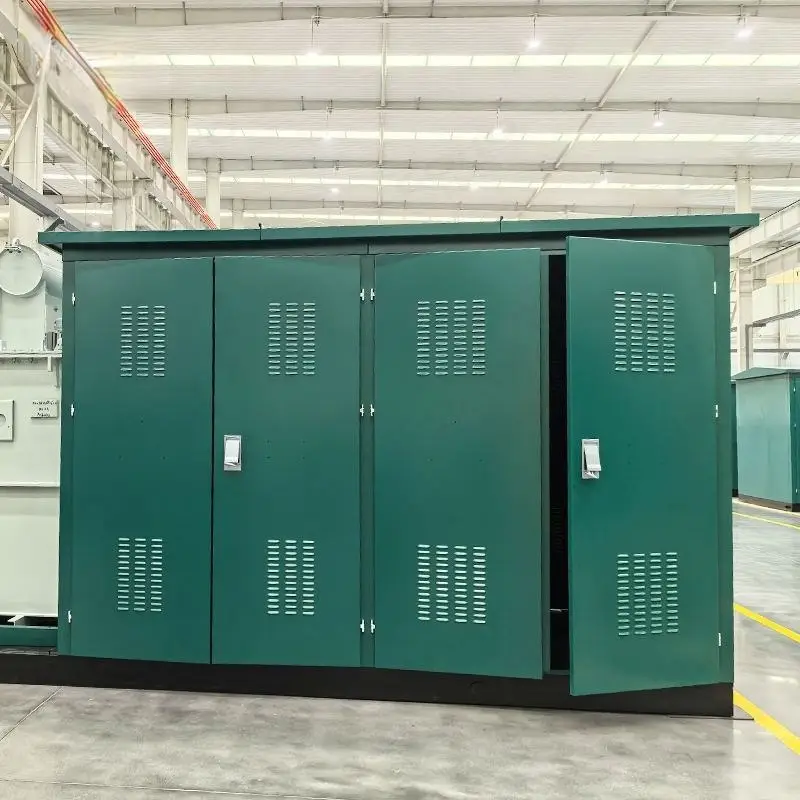
The heart of the plant is the step-up substation. It takes the inverter output — usually 315V to 690V AC — and steps it up to 33kV, 35kV, or 40.5kV for the collector network.
- YBW container-type photovoltaic substations are the standard for solar farms, rated 40.5kV/0.315-0.69kV up to 5000kVA.
- ZFS combined substations handle wind/solar hybrids, with full SCADA monitoring and fiber-optic communication.
If the site is a desert — common in the Middle East — the enclosure spec matters as much as the electrical rating. Anti-corrosion, high-temperature-rated housings that shrug off sand and heat are not optional there; they are the difference between a 20-year asset and a 5-year problem.
The collector network needs switchgear too
Power from multiple substations feeds back through a collector network to the grid connection point. That network needs its own protection and switching:
- GHRM ring main units — compact, sealed-for-life SF6 switchgear that suits a solar farm’s collector feeders.
- KYN61-40.5 — where the grid connection point has higher fault levels and needs full circuit-breaker protection.
The RMU choice is worth attention: a sealed SF6 unit in a desert or coastal site will outperform an air-insulated one by a wide margin, simply because nothing corrosive ever reaches the live parts.
Even a solar farm needs auxiliary power

The plant itself draws power — inverters, monitoring, lighting, cooling. That comes from a small step-down transformer and LV distribution:
- S11-M transformers for auxiliary supply.
- LV switchgear to distribute it.
- Distribution boxes for the final circuits.
It is easy to forget the auxiliary system on a project where the headlines are all about megawatts, but it is what keeps the plant running when the sun is up.
Grid compliance is not optional
Renewable projects have to meet grid connection codes, and three requirements come up constantly:
- Power factor control. Utilities often demand a specified power factor at the connection point. Where the inverters cannot supply it, GGJ capacitor cabinets provide the reactive compensation.
- Low-voltage ride-through (LVRT). The plant must stay connected through grid voltage dips. That is handled by inverter controls working with substation protection coordination.
- Metering and monitoring. Accurate energy metering and remote visibility for both the utility and the operator.
A realistic project layout
| Component | Product | Role |
| Step-up substation | YBW 40.5kV/0.69kV | Step up inverter output |
| Collector switchgear | GHRM RMU | Protect collector feeders |
| Grid connection | KYN61-40.5 | Full protection at the connection point |
| Auxiliary transformer | S11-M | Plant auxiliary power |
| Auxiliary distribution | LV switchgear + boxes | Power plant systems |
Why one supplier changes a solar project
Renewable projects run on tight timelines, and the electrical equipment is on the critical path. Sourcing the substations, switchgear, and transformers together pays off in four ways:
- Coordination. Step-up ratios, protection settings, and busbar systems are designed to match, not patched together.
- Speed. One supplier, one set of drawings, one delivery schedule.
- Monitoring. Substations with built-in SCADA and fiber communication plug straight into the plant control system.
- Commissioning. The whole electrical chain arrives compatible and pre-tested.
About the Author
GOHO Engineering Team — With over 15 years of experience in renewable energy infrastructure, our team designs and produces transformers, switchgear, and prefabricated substations for solar farm and energy storage projects worldwide. All GOHO products comply with IEC 60076, IEC 62271, and IEC 61439 standards. Learn more about GOHO.
Last Updated: September 2026
Related Products & Solutions
For complete low and medium voltage power distribution equipment, explore our full lineup:
- Pillar Equipment: EV charging station, vacuum circuit breaker, soft starter
- LV Switchgear: GGD fixed switchgear, XL-21 power cabinet, GGJ power factor correction capacitor bank
- MV Switchgear: GHRM SF6 ring main unit, KYN28 VCB panel, XGN66 fixed panel
- Transformers & Substations: ZBW prefabricated substation, distribution transformers